January 31st, 2017
Word of the Day: kibitzer (n):
____
In Defense of Affirmations
It is true that we can't control our thoughts, but I do believe that we can train our minds.
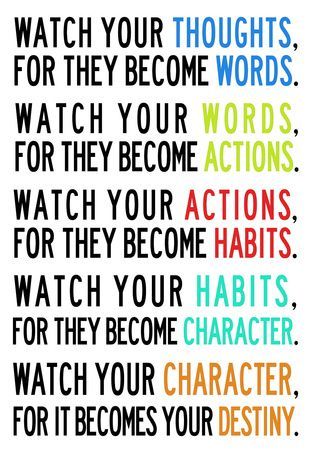
Thoughts often give rise to words (whether internal or external dialogue, writing, communication, etc.), which is turn give rise to actions, which in turn shapes our lives. If we want to change our lives for the better, therefore, it follows that we must elevate our thoughts accordingly.
But how do we do that if we cannot control them? We take a step back and take a look at our words. We can harness the energy of our words as a means to shape our thoughts.
The concept of Right Speech (the 3rd teaching of the Buddha's Noble Eightfold Path) has been prevalent for at least many millennia and across various spiritual traditions (from the Aztec "be impeccable with your word" to the Christian "in the beginning there was the word and the word was God"). This suggests that our word is more than a bond, more than a commitment, more than even a promise - there is an element of the divine within it (as there is in all forms of Self expression), which is why it has the ability to shape our lives and which is why it is so important that we pay attention to our internal and external words.
Whether it is self-criticism, gossip, idle chatter, or some type of falsehood, I invite you to consider what Right Speech means and looks like for you. For example, it is often said that one must T.H.I.N.K before speaking:
Is what I am about to say
True?
Helpful?
Inspiring?
Necessary?
Kind?
For me, I don't think that words need to be "necessary" in order to be spoken. Sometimes there is simple beauty in "unnecessary" gratitude or poetry or even just a musing. Similarly, not all words need to be inspiring. Find what feels right for your Right Speech.
And keep in mind that in order to feel a certain way and in order to manifest certain things in our lives, it is often necessary to act - and speak - ourselves there.
Would you guys like to see daily affirmations on this blog?
What are your thoughts on affirmations? Love them or leave them? Why?
PS Affirmations are path of my Right Speech practice and I have found them to be very helpful and life-elevating. I didn't want to write a post just yet on what my practice looks like or the ins and outs of my experience with affirmations, but if you are interested, let me know (I am also aware that a lot of people strongly dislike affirmations).


Word of the Day: kibitzer (n):
1. one who looks on
and often offers unwanted advice or comment; broadly one who offers opinions.
(I love that Yiddish has a word for this!)
Two Kinds of Intelligence
There are two kinds of
intelligence: one acquired,
as a child in school memorizes facts and concepts
from books and from what the teacher says,
collecting information from the traditional sciences
as well as from the new sciences.
as a child in school memorizes facts and concepts
from books and from what the teacher says,
collecting information from the traditional sciences
as well as from the new sciences.
With such intelligence
you rise in the world.
You get ranked ahead or behind others
in regard to your competence in retaining
information. You stroll with this intelligence
in and out of fields of knowledge, getting always
more marks on your preserving tablets.
You get ranked ahead or behind others
in regard to your competence in retaining
information. You stroll with this intelligence
in and out of fields of knowledge, getting always
more marks on your preserving tablets.
There is another kind of
tablet, one
already completed and preserved inside you.
A spring overflowing its springbox. A freshness
in the center of the chest. This other intelligence
does not turn yellow or stagnate. It's fluid,
and it does not move from outside to inside
through the conduits of plumbing-learning.
already completed and preserved inside you.
A spring overflowing its springbox. A freshness
in the center of the chest. This other intelligence
does not turn yellow or stagnate. It's fluid,
and it does not move from outside to inside
through the conduits of plumbing-learning.
This second knowing is a
fountainhead
from within you, moving out.
from within you, moving out.
____
In Defense of Affirmations
It is true that we can't control our thoughts, but I do believe that we can train our minds.
Thoughts often give rise to words (whether internal or external dialogue, writing, communication, etc.), which is turn give rise to actions, which in turn shapes our lives. If we want to change our lives for the better, therefore, it follows that we must elevate our thoughts accordingly.
But how do we do that if we cannot control them? We take a step back and take a look at our words. We can harness the energy of our words as a means to shape our thoughts.
The concept of Right Speech (the 3rd teaching of the Buddha's Noble Eightfold Path) has been prevalent for at least many millennia and across various spiritual traditions (from the Aztec "be impeccable with your word" to the Christian "in the beginning there was the word and the word was God"). This suggests that our word is more than a bond, more than a commitment, more than even a promise - there is an element of the divine within it (as there is in all forms of Self expression), which is why it has the ability to shape our lives and which is why it is so important that we pay attention to our internal and external words.
Whether it is self-criticism, gossip, idle chatter, or some type of falsehood, I invite you to consider what Right Speech means and looks like for you. For example, it is often said that one must T.H.I.N.K before speaking:
Is what I am about to say
True?
Helpful?
Inspiring?
Necessary?
Kind?
For me, I don't think that words need to be "necessary" in order to be spoken. Sometimes there is simple beauty in "unnecessary" gratitude or poetry or even just a musing. Similarly, not all words need to be inspiring. Find what feels right for your Right Speech.
And keep in mind that in order to feel a certain way and in order to manifest certain things in our lives, it is often necessary to act - and speak - ourselves there.
Would you guys like to see daily affirmations on this blog?
What are your thoughts on affirmations? Love them or leave them? Why?
PS Affirmations are path of my Right Speech practice and I have found them to be very helpful and life-elevating. I didn't want to write a post just yet on what my practice looks like or the ins and outs of my experience with affirmations, but if you are interested, let me know (I am also aware that a lot of people strongly dislike affirmations).